In one of our last posts “Finland and Estonia through a child’s eyes – Involving children in the co-creative process of Wear-Abouts products creation” we have discussed the main themes to be addressed through co-design activities involving children:
Designing ‘for’ and ‘with’ children, means taking into account how children ‘see’ themselves through the products to be created and how they would best use them. It means to find a way to see through their eyes, through observation and discussions with them, but as also to add an adult vision for a deeper understanding of what could lead them towards a better living and future.
“Children are skillful communicators capable of expressing themselves in many different ways, and they actively contribute to, and influence, the world around them. As experts of their own experiences it is important to include them in decisions regarding their own way of life.” – Co-Design with Children, Anja Stedjeberg Hansen
Therefore children become co-researchers of the development process, as we encourage them to explore a specific field and to co-partner with them, as real team members. This process enables co-creation and participatory design with children as well as considering the whole family and parental context. It allows for time spent together on a continuous basis and in a natural manner, as the best way to learn from children and to pay more attention to how they evolve in different contexts.
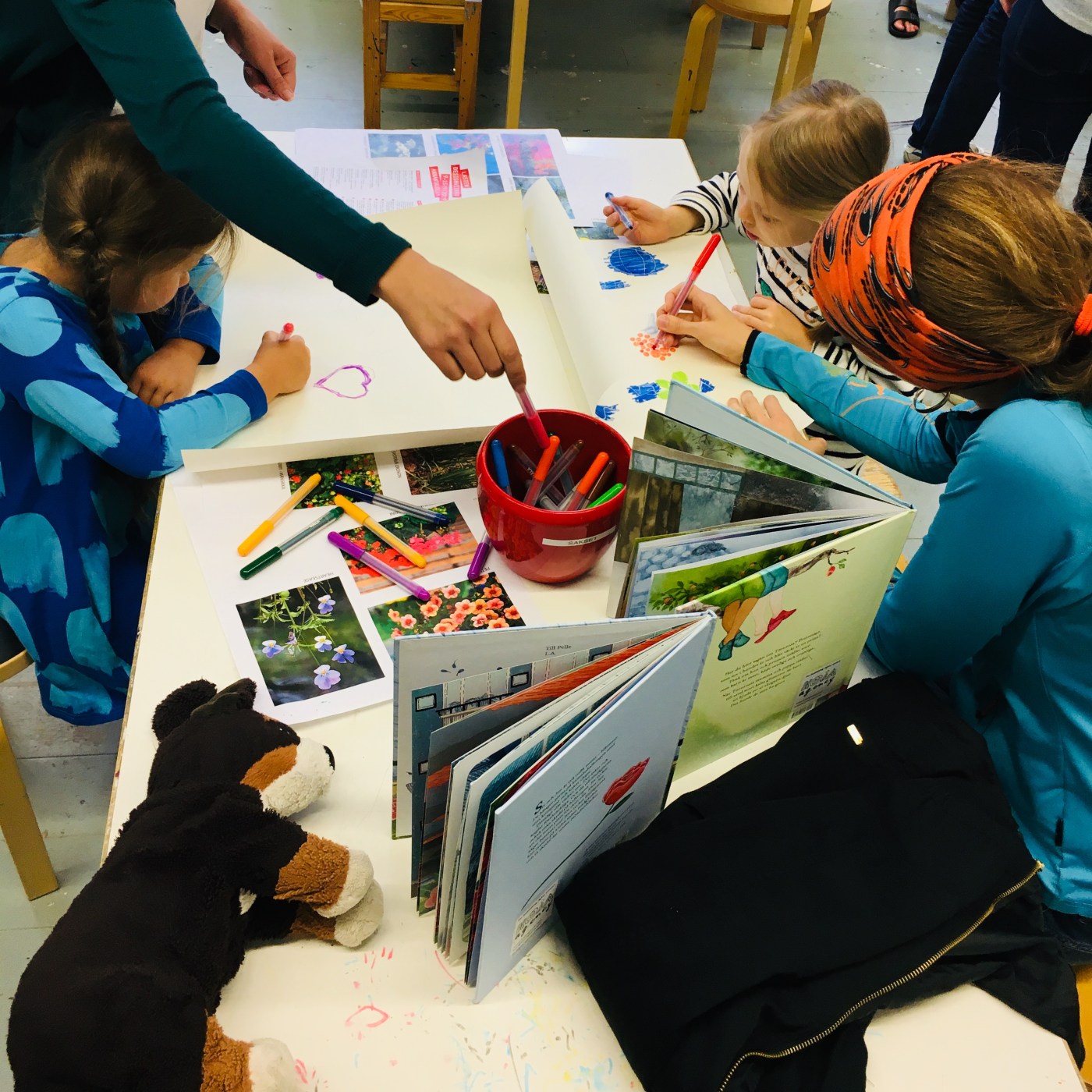
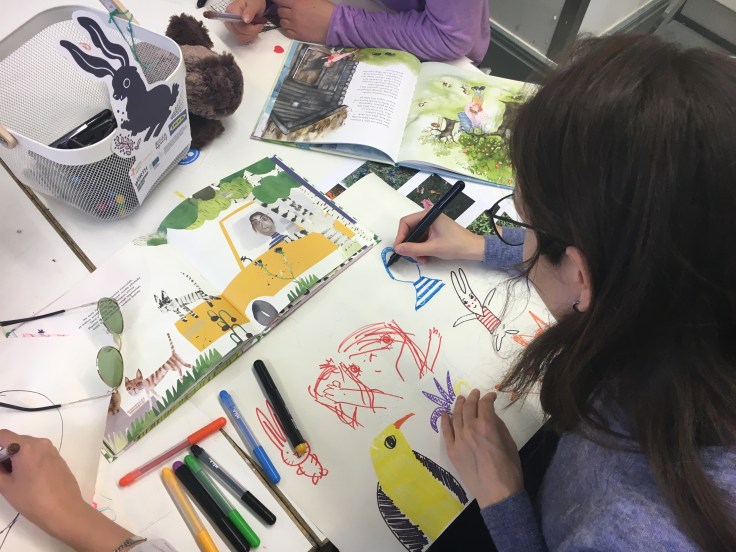
On the occasion of the Helsinki Children’s Design Week 2019 we conducted a second Observation phase based on discovery and research. Children benefited (compensation) from free workshops and space with free materials (fabric and paper, fabric and standard markers, books to find inspiration on the theme of the garden, nature and climate in the Baltic Sea countries) to experiment around drawing on fabric, pattern making as well as uncover pre-printed elements related to sustainable development (symbols and words). As well they have been invited to display their creations (through pictures) at the successive online exhibition related to these ‘secret garden’ workshops. Like the children, parents have been informed about this exhibition and have received the link to e-visit it.
This observation stage, which is a continuous one in the framework of a Lean methodology (testing through experimentation cycles), is leading us to the Definition phase and the Prototyping phase.
Wear-Abouts core principles are based on alternative education approaches, such as positive psychology, outdoor education, autonomous education, which are important and emerging approaches in Europe and beyond, more focused on children-parents relations and wellbeing as well as children’s development as individuals.
The research phase is based on 5 key children’s development needs:
- Health
- Social skills
- Relate with others
- Learning
- Parenting capacities
Health
Spend energy
During the Helsinki Children’s Design Week, sun as well as rain have been playing hide and seek with us. No surprises there!
While we were waiting for the participating school classes, we have seen a funny movement of coming and going in the Annantalo Arts Center yard. Finnish children were prepared and dressed accordingly. No matter the weather (or almost) children go for outdoor activities.
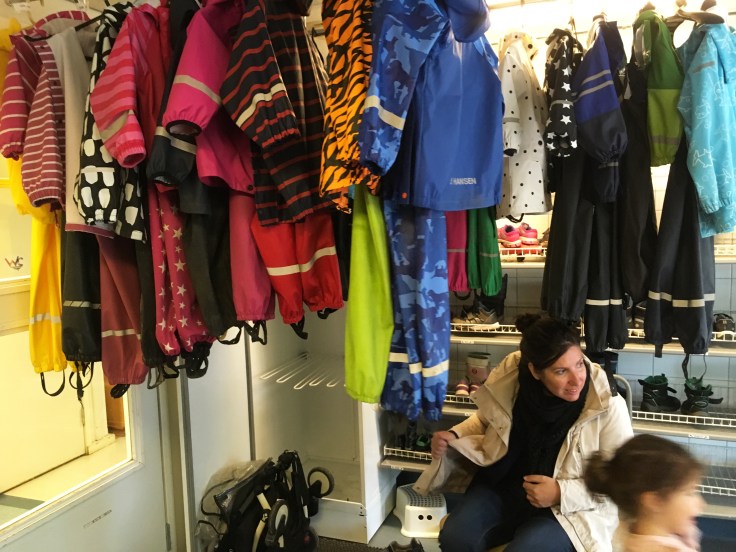
Nevertheless, once the rain clothes are taken off, very nice indoor outfits are revealed. We couldn’t resist posting a small selection of the most nice and funny ones…


Practical but somehow ‘Finnish smart’ as well!
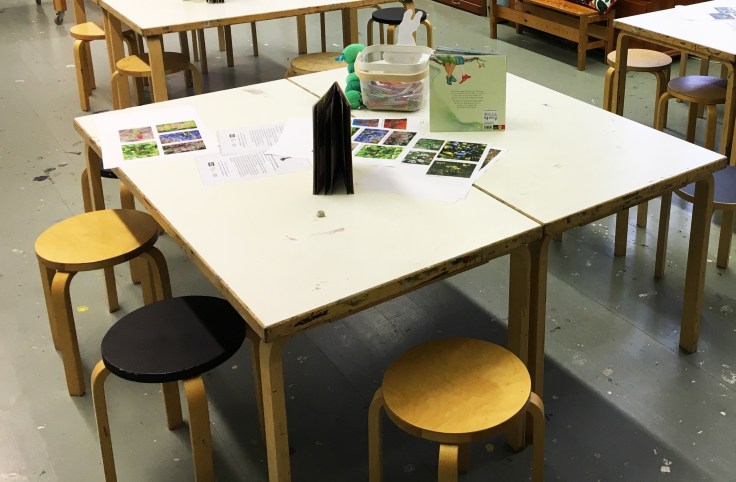
Finnish design doesn’t stop here… sure you will recognize copies of this Alvar Aalto design icon… originally created in 1933!!
(https://finland.fi/arts-culture/aaltos-stool-60-has-legs/)
Such a nice stool but so much energy emanating from our small participants…we can’t resist (again!) to photograph the funniest positions…


Outdoor connections
For a child, there is nature AND nature… it is a concept that acquires different understandings, from the more conventional representations to the most original ones.
We’ve enjoyed discovering connections to local outdoors elements, drawn by children in their very own, but amazing, way. We have provided illustrated books for children from Estonia and Sweden, to serve as sources of inspiration, and we have had some interesting reuses as well.


Though we have been also surprised by the amount of somehow standard representations of nature and its symbols, in a country where nature is very present and should trigger the depiction of more strongly recognizable symbols. Regarding the definition of what is nature for a child, we need to highlight the importance of learning references (local or international), such as illustrated books.
Social skills and relate with others
Do by myself/not too far
The Secret garden workshops have been ideated for families and built mostly around children needs. They offer the opportunity for children and their accompanying families to spend time together, while also very important granting to children autonomy in the drawing process. It is interesting to highlight how a drawing workshop – drawing being an activity quite common for children – has attracted so many families and children, who spent quite some time at it. Drawing is a timeless and fundamental activity. It never gets old!
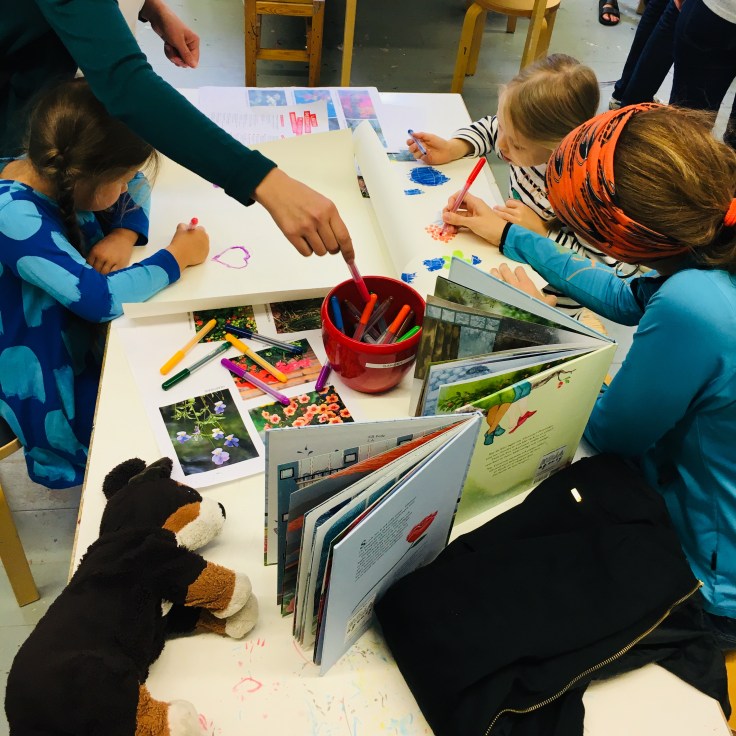
Children were at the same time given pieces of fabric or paper holding a secret message that could be revealed in a natural and free manner by children while they were drawing. Parents were repeating or explaining the few instructions given by us as well as helping children when they expressed the need for it. The inter-generational aspect of the activity was obvious, notably the presence of brothers and sisters of very different ages, from babies to teenagers.
Meet
While the workshops were clearly a social activity – families discussing with each other, our team getting to know parents and children – it was also an opportunity for children to meet illustrated universes from the Estonian and Swedish books provided, as well as the given picture boards of local plants. Some of them have been very inspired by these universes.
Change perspective
During the workshops perspectives changed in different ways. Some parents were surprised by the ability of their very young children to draw or interact with them (we had a special activity for babies with their parents). Smaller ones even climbed on stools and tables to be able to reach the whole page of paper!


Some children welcomed their parents to draw together while some other parents even did their own creations!


Experience through play
Play has been a common thread throughout the 3 days of workshops. Children’s drawing experience was constantly interrupted by interactions with the materials and toys available (courtesy of Ikea Finland – Vantaa) as well as improvised games with other children.


The use of fabric and the activity of drawing on fabric have been rewarding and we learned a lot through this experience. Children had to face issues with fabric, which they didn’t have to deal with when using paper, and found ingenious solutions to be able to draw properly on it. Though the use of the fabric material itself could have been improved, presenting first what is fabric and different types of fabric and then what kind of printing can be made on it. At this first version of the workshops, we have presented only the repeated pattern design process through a nice intervention of Elina Savolainen, Finnish designer and illustrator specializing in pattern design.


We have also received the visit of the Finnish illustrator Miila Westin who worked with us on the very first Wear-Abouts prototype collection.


The workshop experience led us to several conclusions that will be considered for the organization of future workshops:
- HEALTH – Spend energy/outdoor connections: We have confirmed that a workshop activity is an outdoor outing opportunity in itself, for families. While the workshops themselves were held indoor, schools and families came and sometimes even braved the bad weather, avoiding a day locked up at home. The Secret garden theme was inspired by the parallel activity held in the Annantalo yard, the creation of a real seasonal vegetable garden. Therefore it is always interesting to link the workshops to an outdoor opportunity and try to make the link, especially as it is the core aspect of Wear-Abouts. Allowing also children to move and play during the workshop is an important perspective that we’ll see in the PLAY section of the conclusion.
- SOCIAL SKILLS and relate with others – Do by myself/not too far: We do believe that, in our workshops, parents and family should participate. First because it allows for additional time spent together, in moments when children don’t see their parents so often to spend real quality time together. Workshops are therefore an extra opportunity to do this, but also to help parents go out of their comfort zone and experiment with their children things they might never experiment on their own. It is also helping to propose inter-generational activities, older children sharing with smaller siblings the activity. We have seen that it has enabled very young children to draw, while parents thought they wouldn’t be interested in drawing at their age.
- LEARNING THROUGH PLAY: The use of play, associated with the drawing activity is something we would really like to explore further. Sitting for a certain period of time can be a difficult task for some children who are rather active (and as we are not at school, they could be encouraged to move if they feel like doing so) as well as for smaller ones, whose discovery system manifests through physical exploration. Therefore we will try to introduce in the future a different use of the space and furniture as well as modules/elements available for play, that stands thematically in relation with the drawing or designing activity.
In the next blog article we’ll talk about the next steps for co-design with children in the framework of the Wear-Abouts project: the Definition and Development phases involving children as designers as well as prototype test sessions (including play sessions) with children and families.

 WEAR-ABOUTS - The blog